

Stablecoin Market Boom to $300B Is ‘Rocket Fuel’ for Crypto Rally
Stablecoins have quietly become the backbone of digital asset markets. As the total stablecoin market cap accelerates toward the $300 billion mark, many analysts argue that this expansion is “rocket fuel” for the next crypto rally. Why? Because stablecoins are the crypto economy’s working capital – the dry powder that lubricates trading, liquidity provision, and on-chain commerce.
In this deep dive, we unpack why a $300B stablecoin float matters, how it amplifies liquidity across Bitcoin, Ethereum, and altcoins, and what signals to track as this segment continues to scale. Whether you’re a trader, founder, or enterprise leader, understanding stablecoin dynamics is now essential.
Table of Contents
- Introduction: Why Stablecoins Matter Now
- What Are Stablecoins and Why Do They Grow?
- Why the $300B Milestone Is Pivotal
- Liquidity Mechanics: How Stablecoins Power Crypto Markets
- Impacts Across the Crypto Stack
- Regulatory Clarity and the Path to Scale
- Key Risks and How to Manage Them
- Metrics to Watch: On-Chain and Off-Chain Signals
- Scenarios: $250B, $300B, $400B+
- Practical Tips for Traders, Builders, and Businesses
- Case Study: The 2020-2021 Stablecoin Surge
- Conclusion: Stablecoins as the Crypto M2
Introduction: Why Stablecoins Matter Now
Stablecoins are dollar-pegged (or fiat-pegged) tokens that move at the speed of the internet. They are used to trade crypto, settle cross-border payments, fund DeFi strategies, and serve as a safe harbor during turbulence. As the market cap of stablecoins grows, so does the liquidity base for the entire digital asset ecosystem.
Today, macro tailwinds – from rising tokenization of real-world assets to expanding global demand for dollar-based settlement – are converging with better infrastructure and improving policy clarity. Together, these forces are pushing stablecoins toward a potential $300B aggregate market cap, a level many view as a catalyst for broad-based crypto appreciation.
What Are Stablecoins and Why Do They Grow?
Stablecoins come in several flavors, with fiat-backed coins like USDT and USDC dominating market share. Their growth reflects:
- Global demand for dollar exposure and instant settlement, especially in emerging markets.
- Institutional use cases: on/off-ramps, treasury management, and liquidity provisioning.
- Yield dynamics: reserves held in short-term U.S. Treasuries generate interest, funding infrastructure and incentives.
- DeFi adoption: stablecoins are the base collateral and quote currency for many protocols.
Main Categories of Stablecoins
- Fiat-backed: Fully reserved in cash/T-bills (e.g., USDT, USDC).
- Crypto-collateralized: Overcollateralized with crypto assets (e.g., DAI).
- Hybrid/RWA-backed: Collateral includes tokenized T-bills and money market assets.
Why the $300B Milestone Is Pivotal
A $300B stablecoin market cap is more than a round number-it’s a structural shift. Consider these effects:
- Deeper Liquidity: More tight bid-ask spreads, reduced slippage, and improved price discovery across exchanges.
- Faster Transmission: Capital can move across chains and venues instantaneously, enabling arbitrage that keeps markets efficient.
- Institutional Comfort: A large, liquid stablecoin float signals maturity, supporting ETF flows, market makers, and corporate adoption.
- DeFi Reacceleration: Larger stablecoin balances often precede increases in Total Value Locked (TVL), spurring innovation and yields.
- Dollar Infrastructure: Stablecoins extend the reach of the U.S. dollar into on-chain rails, fueling global payments and remittances.
In short: stablecoins are the crypto economy’s money supply. When the supply expands healthily, it can stimulate activity – just as M2 growth often correlates with broader economic expansion.
Liquidity Mechanics: How Stablecoins Power Crypto Markets
Stablecoins influence prices and volumes through clear channels:
- Exchange Reserves and Flow
- An uptick in stablecoin balances on centralized exchanges (CEXs) often signals “dry powder” ready to rotate into BTC, ETH, and altcoins.
- On-chain liquidity pools (AMMs) deepen as providers pair stablecoins with volatile assets, attracting more traders.
- Arbitrage and Price Parity
- Liquid stablecoins allow fast arbitrage between exchanges, keeping spreads tight and prices aligned.
- Stable peg maintenance benefits from liquid secondary markets and robust redemption channels.
- Collateral and Credit
- Stablecoins are prime collateral in DeFi lending, enabling leveraged strategies and market-making.
- More stablecoin collateral generally supports higher credit capacity safely, when risk managed.
- Settlement and Treasury
- Funds, trading firms, and corporates use stablecoins for 24/7 settlement, reducing counterparty and banking hours risk.
- Faster settlement cycles free up capital, increasing market throughput.
Impacts Across the Crypto Stack
Bitcoin
- Stablecoin inflows to exchanges can precede upward BTC momentum as sidelined capital rotates in.
- Tighter spreads and deeper books reduce the cost of large orders, encouraging institutional participation.
Ethereum and L2s
- Stablecoins are the main medium of exchange in DeFi and NFT marketplaces, especially on Ethereum and layer-2 networks.
- Gas-efficient L2s further enhance stablecoin velocity and cross-venue arbitrage, amplifying liquidity effects.
Altcoins
- Smaller-cap assets benefit disproportionately from improved stablecoin liquidity because slippage falls and market depth rises.
- New listings paired with liquid stablecoins list smoothly and can scale faster.
DeFi Protocols
- Higher TVL in stablecoin pools increases routing efficiency and yield opportunities.
- Structured products and perps markets thrive with abundant, low-volatility collateral.
Payments and Remittances
- Merchants and fintechs adopt stablecoins for low-cost, cross-border payments with near-instant settlement.
- In regions with inflation or capital controls, stablecoins provide a practical dollar alternative.
Regulatory Clarity and the Path to Scale
Policy clarity is a major unlock for stablecoin adoption. Jurisdictions are converging on frameworks that emphasize reserve quality, transparency, and redemption rights. Key themes include:
- High-Quality Reserves: Short-dated U.S. Treasuries, cash, and similar instruments.
- Audits and Attestations: Regular, independent reporting on reserve composition and liquidity.
- Issuer Licensing: Clear supervisory regimes and consumer protection standards.
- Interoperability: Compliance-friendly bridges across chains and traditional payment systems.
The result: more institutions feel comfortable holding and transacting with stablecoins, growing the float and unlocking use cases from payroll to trade finance.
Key Risks and How to Manage Them
Stablecoins are not without risk. Market participants should understand:
- Peg Stability: Stress events can cause temporary deviations; robust redemption and liquidity help restore parity.
- Reserve Risk: Transparency into reserve composition and duration is crucial for evaluating safety.
- Counterparty/Issuer Risk: Legal protections, bankruptcy remoteness, and asset segregation matter.
- Regulatory Shifts: New rules can impact issuance, redemptions, and cross-border transfers.
- Smart Contract/Bridge Risk: Technical exploits can impair wrapped or cross-chain stablecoin variants.
Risk management best practices include diversifying stablecoin exposure, verifying issuer attestations, preferring well-audited smart contracts, and maintaining contingency liquidity.
Metrics to Watch: On-Chain and Off-Chain Signals
For a data-driven view of stablecoin-driven momentum, track:
| Signal | Why It Matters | What’s Bullish |
|---|---|---|
| Stablecoin Market Cap | Indicates money supply/dry powder | Consistent growth toward/above $300B |
| Exchange Stablecoin Balances | Potential buy pressure | Rising balances on major CEXs |
| On-Chain Velocity | Economic activity indicator | Higher transfer volume, active addresses |
| DeFi TVL (Stablecoin Pools) | Depth and routing quality | Expanding TVL with healthy yields |
| Peg Deviations/Redemptions | Stress test of stability | Tight pegs, orderly redemptions |
| Regulatory Milestones | Institutional comfort | New licenses, clearer rules |
Scenarios: $250B, $300B, $400B+
How might different stablecoin market sizes translate to crypto conditions? The numbers below are directional scenarios, not forecasts.
| Market Cap Level | Market Conditions | Likely Effects |
|---|---|---|
| $250B | Late accumulation | Improved liquidity; BTC/ETH lead |
| $300B | Breakout liquidity | Altcoin breadth; tighter spreads |
| $400B+ | Institutional scale | Payments surge; deeper derivatives |
As stablecoin supply climbs, watch breadth: does activity broaden from majors to mid-caps? Do perps funding and basis normalize? Are CEX/CEX arbitrage spreads compressing? These are hallmarks of healthy liquidity expansion.
Practical Tips for Traders, Builders, and Businesses
For Traders and Investors
- Track stablecoin exchange inflows/outflows to gauge near-term buy pressure.
- Use stablecoins for fast settlement, risk-off positioning, and basis trades.
- Diversify stablecoin exposure by issuer and chain; verify attestation reports.
- Monitor peg stability during volatility; prefer deep-liquidity pairs.
For Builders and Protocol Teams
- Integrate multiple stablecoins to reduce single-issuer risk and improve UX.
- Design incentives around real, sustainable yields (e.g., RWA income streams).
- Optimize for L2s and cross-chain liquidity routing to boost velocity.
- Publish transparent risk dashboards for collateral, liquidity, and oracle data.
For Businesses and Treasuries
- Use reputable, regulated issuers for payables/receivables and cross-border settlement.
- Establish policy around redemptions, custody tiers, and compliance screening.
- Pilot stablecoin-based payouts for contractors in high-fee corridors.
- Evaluate tokenized T-bill funds for treasury yield while maintaining liquidity.
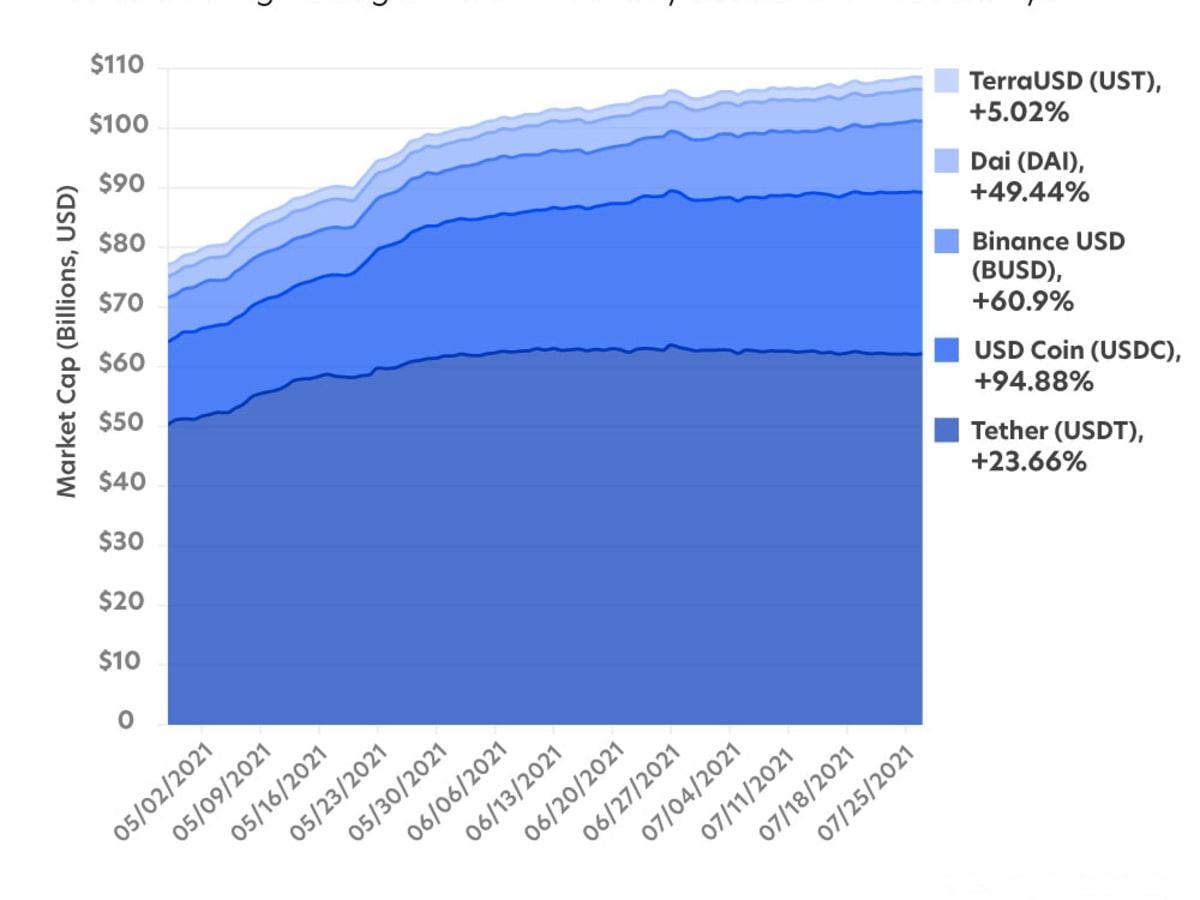
Case Study: The 2020-2021 Stablecoin Surge
Looking back offers clues. During 2020-2021, stablecoin market cap expanded explosively alongside the bull market. While causation is complex, correlations were notable:
- Stablecoin supply growth preceded periods of rising crypto market cap, suggesting liquidity led risk-taking.
- DeFi TVL surged as stablecoins became core collateral, driving innovation in lending, AMMs, and derivatives.
- Arbitrage efficiency increased, as stablecoins enabled rapid cross-exchange capital mobility.
The lesson: sustained, high-quality growth in stablecoin float can be a leading indicator of broader crypto market expansion, provided pegs remain stable and regulation keeps pace.
Conclusion: Stablecoins as the Crypto M2
Framed simply, the total stablecoin market cap is the crypto economy’s functional M2 – the liquid money that powers trading, lending, and payments. A boom toward $300B, supported by robust reserves, clear regulations, and real-world utility, is rightly called “rocket fuel” for a crypto rally. It deepens order books, tightens spreads, energizes DeFi, and invites institutions to scale up.
Still, quality matters as much as quantity. The healthiest path is gradual, transparent growth with strong pegs, high-quality reserves, and diversified issuers across multiple chains. Watch the metrics, manage the risks, and prepare for a world where stablecoins are not just an on-ramp to crypto – they are the rails on which the digital economy runs.
Disclaimer: This article is for informational purposes only and does not constitute financial, investment, or legal advice.